Estonian American National Council Announces 2026 EANC Henrik Visnapuu Award Recipients
The 2026 EANC Henrik Visnapuu Culture and Literature Award was presented to literary scholar Janika Kronberg and poet Reijo Roos.
The Estonian American National Council (EANC) has announced the recipients of the re-established Henrik Visnapuu Cultural and Literary Award. This year’s honorees are literary scholar Janika Kronberg, who receives the Lifetime Achievement Award, and poet Reijo Roos, who is recognized as an Outstanding Young Author. The award ceremony took place at the Tallinn Estonian Writers’ House on Wednesday, January 7th at 6pm.
Epp Annus, chair of the Jury and member of the Estonian American National Council, reflected on the jury’s work:
“Once again, the EANC Visnapuu Award jury faced a challenging task: how does one evaluate and compare achievements realized in different forms and for different purposes? How can one weigh film, musical compositions, works of fiction, literary-historical scholarship, and memoirs reflecting on a rich and dignified life? It was a pleasure to note that there were more prizeworthy candidates than awards available. Fortunately, the award guidelines allow for candidates to be nominated again in future years.“
In this year’s competition, we received a total of fourteen candidates from the United States, Finland, France, the Netherlands, and Estonia, representing the fields of fiction, visual culture, politics, music, and cultural studies. The jury reached its decision unanimously.
Lifetime Achievement Award: Janika Kronberg
As a literary scholar, Janika Kronberg has focused primarily on Estonian exile literature produced after the Second World War—literature that, at the time of its publication, was inaccessible to most readers in Soviet-occupied Estonia and therefore lacked meaningful reception even when it reached the
homeland by chance.
In an article dedicated to Estonia’s Year of the Book, Janika Kronberg writes:
“For a long time, two Estonian-language literatures lived and developed separately. In 1968, Endel Nirk—one of the authors and editors of the seven-volume History of Estonian Literature (1965–1991)—was forced to admit that ‘perhaps it would be more proper to leave emigrant literature out altogether.’” (1)
Janika Kronberg has worked consistently to weave these two literary traditions into a single, unified Estonian literature. He has authored numerous articles and lectured to Estonian communities around the world. His published works include Under the Sign of the Winged Horse, Journeys with Six Guides, Carefully Chosen Friends, Read and Connected, Kröits ehk Ristikivi (co-authored with Brita Melts), and most recently Three Karls.
Kronberg’s work is never written from a purely academic distance. In addition to extensive archival research, he has sought to understand and experience the paths of the writers he studies by physically retracing their journeys—for example, following Karl Ast-Rumor in Morocco and Karl Ristikivi in Greece.
Literary scholar Rein Veidemann has noted:
“It is fascinating to see how Kronberg, through associations, connections, and references, weaves a cultural fabric from diverse threads. By recalling human relationships, Estonian literary and cultural history acquires an intimate, almost local-history dimension.”
Unlike Jaan Kross, who approached key figures in Estonian cultural history as a novelist—allowing himself conscious fictionalization and artistic generalization—Kronberg remains firmly grounded as a scholar. His culturally rich excursions are also historically and factually sound.
Through his work, Janika Kronberg has bound together homeland and exile literature into a multilayered, finely textured temporal and spatial whole. Alongside his scholarship, he has held several major leadership roles in Estonian literary life, including Director of the Estonian Literary Museum, Head of the Tartu branch of the Estonian Writers’ Union, and Editor-in-Chief of Looming.
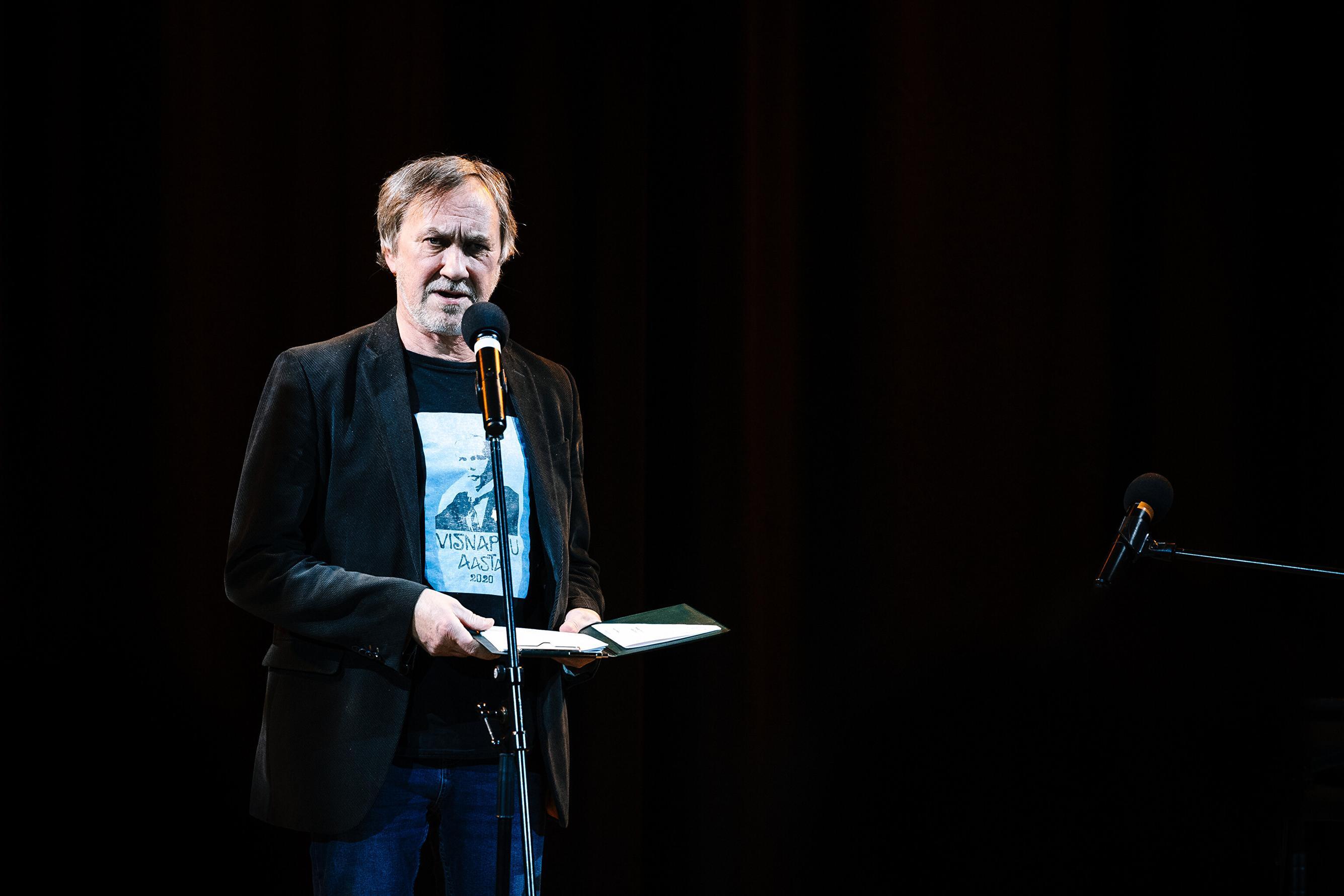
Visnapuu awards were presented at the Writers’ House. Author/Source: Ken Mürk/ERR.
Award for Outstanding Young Author: Reijo Roos
Reijo Roos s (b. 2003) is a catalyst for his generation and a builder of the Finnish-Estonian cultural bridge. While still a secondary-school student, he compiled the bilingual poetry anthology Sinisild / Sinisilta (2020). The following year, he founded Kirjanike Liidu Noored (Young Writers of the Writers’ Union) and soon thereafter launched its annual almanac, Grafomaania.
Roos’s second book, Tere kas tohib / tere kas võisõ (2023), is a trilingual collection featuring poetry in Estonian, Võro, and Finnish. Currently studying in Helsinki, Roos himself embodies the living Finnish-Estonian bridge. His energy and initiative have played a significant role in activating literary collaboration among young writers of his generation and in connecting generations more broadly.
In today’s geopolitical context, maintaining the Finnish bridge is not only a creative and spiritual endeavor, but also an act of strategic and European significance. While Reijo Roos is clearly a talent of the future, he has already accomplished an extraordinary amount at a young age. Jury member Jürgen Rooste notes: “During the pandemic years, he was one of the few young authors whom one could find, year after year on January 2, at Visnapuu’s grave…”
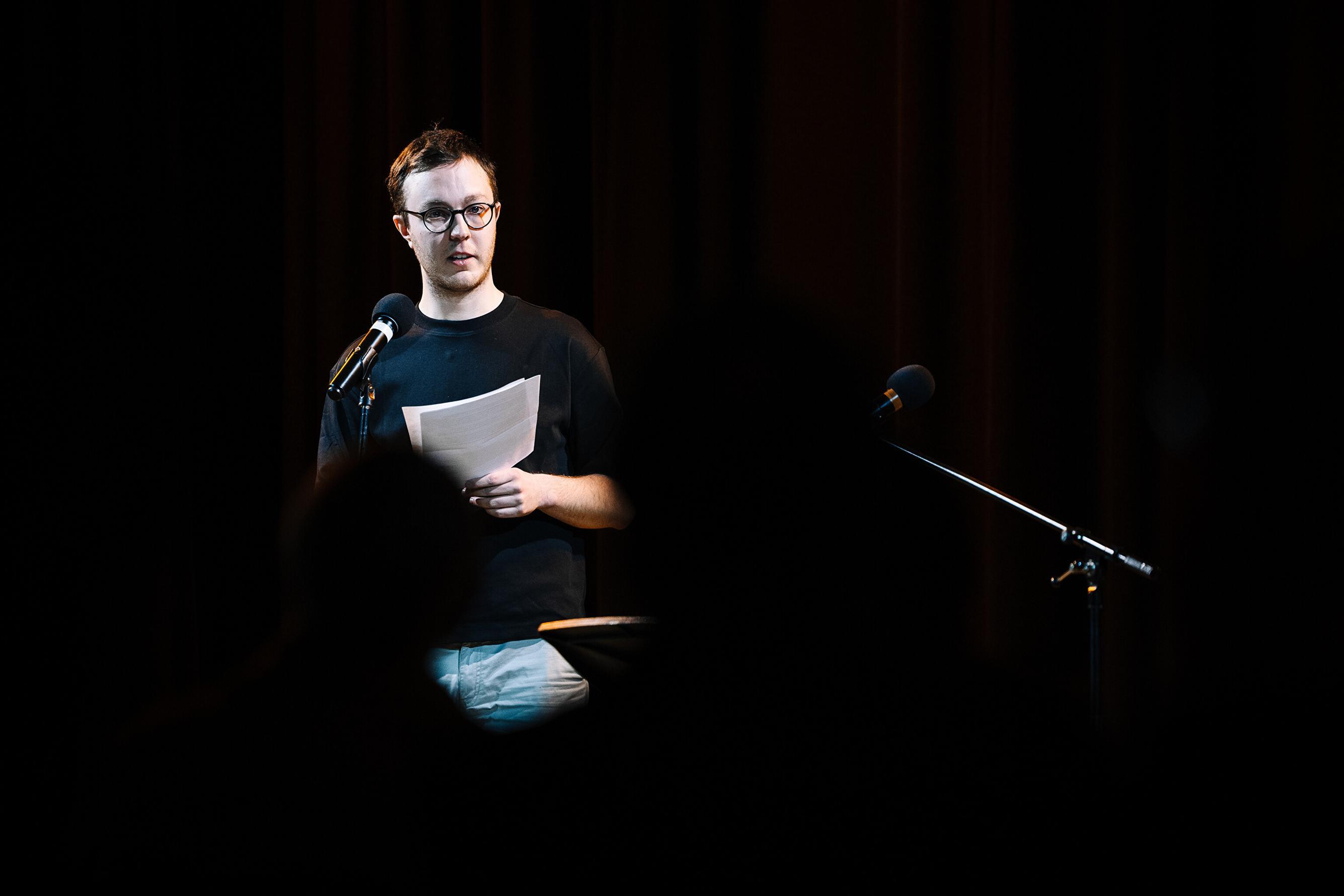
Visnapuu awards were presented at the Writers’ House. Author/Source: Ken Mürk/ERR.
EANC and Its Partners
The Estonian American National Council awards the Henrik Visnapuu Prize in cooperation with its Estonian partners: the Estonian Writers’ Union and the Municipality of Luunja, Visnapuu’s home parish in Estonia. In 2026, EANC will award a $3,000 prize to each winner. A unique piece of art is commissioned specifically for the award each time by an Estonian artist; its cost is covered by the Municipality of Luunja.
The jury consisted of Epp Annus (literary scholar and writer, representing EANC), Jürgen Rooste (poet, representing the Estonian Writers’ Union), and Toomas Liivamägi (Principal of Luunja Secondary School, representing the Municipality of Luunja).
Previous recipients of the EANC Henrik Visnapuu Award include Elin Toona (2021) and Tiina Kirss (2023).
History of the Henrik Visnapuu Award
The Henrik Visnapuu Literary Award was originally established in the United States in 1952 and was awarded until 2007. Following the deaths of the founders of the award fund, the prize was discontinued. In 2020, EANC restored the Visnapuu Award, deciding to present it biennially and expanding its scope to a broader cultural award.
The award honors an Estonian-themed work published in Estonian or another language, in the fields of prose, poetry, memoir, or scholarly research, music, film, performing arts. Works published both in Estonia and abroad are eligible, with preference given to Estonian or Estonian-diaspora works published outside Estonia that help bring Estonian culture and history to wider international awareness.
The Estonian American National Council, founded in 1952, is the nationally elected representative organization of Estonian Americans. Its mission is to represent the interests of Estonian Americans and to preserve and promote Estonian language and culture. More information is available at www.estosite.org
Henrik Visnapuu (1890–1951)
Henrik Visnapuu was born on January 2, 1890, in Helme parish. He fled Soviet occupation in 1944, first to Germany, and emigrated to the United States in 1949. He died on April 3, 1951, on Long Island, New York, at the age of 61. In June 2018, his remains were reinterred at Tallinn’s Metsakalmistu Cemetery beside his wife, Hilda Visnapuu (Ingi), who had waited there for him for over seventy years.
One of the most prolific and versatile figures in Estonian literature, Visnapuu authored more than thirty works, including over twenty poetry collections, memoirs, plays, verse novels, long poems, and essays. As a senior civil servant, he played a significant role in shaping Estonian cultural policy in the late 1930s as well as during the war and occupation years (1940–1944).
Visnapuu holds a central place in Estonian cultural history—as a core member of the Siuru literary movement, as a classic poet of love and patriotic verse, and as a key figure in exile cultural life. He was a founder of the Worldwide Estonian Literature Society, the author of Estonia’s first comprehensive poetics textbook, editor of the journal Varamu, and a driving force behind the Estonian Writers’ Cooperative.
Contacts:
- Sirje Kiin, EANC Visnapuu Award Committee chairman: sirjekiin@hotmail.com
- Epp Annus, literary scholar and chairman of the jury epp.annus@gmail.com
- Jürgen Rooste, poet and jury member (representing Estonian Writers’ Union) armastatudpoeet@hotmail.com
- Learn more about the Henrik Visnapuu Award and other EANC initiatives at www.estosite.org
- Further reading and where to find the laureates’ works: www.estosite.org/eanc-henrik-visnapuu-award
(1) „Eesti raamat paguluses kirjanduse järjepidevust hoidmas“ – Postimees 6.12.2025
(2) Kirjanduslik road-story. – Postimees 18.1.2014